
If you’ve ever tried to get a quote for a 3D model, you know the frustrating answer: “it depends.” One studio quotes you $200, another quotes $4,000, and a freelancer on a marketplace offers to do it for $50. All of them might be telling the truth — because 3D modeling pricing swings wildly based on complexity, purpose, experience level, and delivery format.
In 2026, that variability has only grown, thanks largely to AI-assisted modeling tools reshaping the low end of the market while high-end specialist work holds steady or even climbs. This guide breaks down what you can realistically expect to pay, what drives the price up or down, and how to budget for your specific project.
The Short Answer
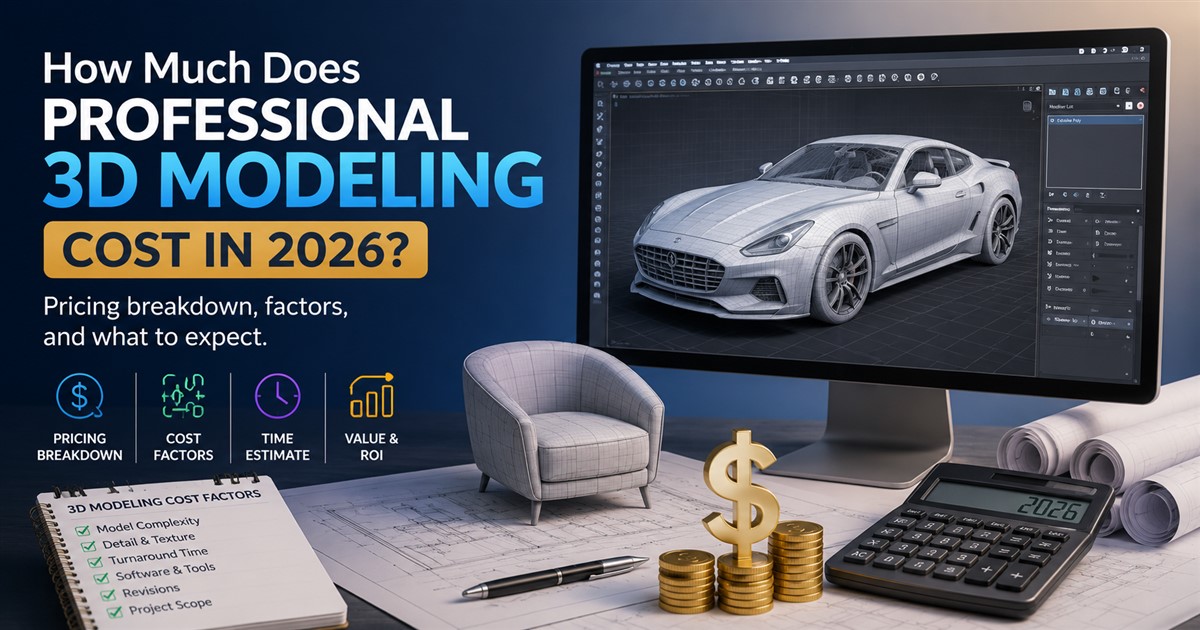
For most business and creative projects, professional 3D modeling costs somewhere between $25 and $220 per hour, or $50 to several thousand dollars per finished asset, depending on complexity. Architectural visualization and product renders are usually quoted per image or per package rather than by the hour, with typical ranges of $250 to $5,000 per finished render.
Here’s a quick breakdown by engagement type:
- Junior freelancers: $20–$40/hour
- Mid-level freelancers: roughly $50–$80/hour
- Senior specialists (8+ years, niche expertise): $100–$220/hour
- Per-asset pricing (simple props, basic characters): $30–$200 per asset
- Complex architectural or character models: several hundred to several thousand dollars
- In-house full-time hire: roughly $78,000–$125,000/year base salary, with total employer cost often running close to double that once benefits, software, and hardware are factored in
Let’s unpack why the range is so wide.
Pricing Tiers by Experience Level
Like most creative and technical fields, 3D modeling pricing scales closely with experience and specialization.
Entry-level / junior modelers typically charge between $20 and $40 per hour. They’re a good fit for simple, well-defined tasks — basic props, straightforward geometry, or work that follows a clear reference with minimal creative interpretation required.
Mid-level modelers, averaging around $50–$80 per hour, are usually the sweet spot for most commercial projects. They can handle moderately complex work like product visualization, environment pieces, or basic character modeling without the premium price tag of a senior specialist.
Senior artists and specialists, generally with 8 or more years of experience, charge $100–$220 per hour. These are the people you hire for character work, hard-surface modeling for games, or any project where the visual quality directly affects a product launch, investor pitch, or ad campaign. Their rates reflect not just modeling speed but design judgment — the ability to solve problems without excessive revision cycles.
Geography plays a role too. Freelancers based in North America and Western Europe tend to sit at the top of these ranges, while modelers in other regions may offer comparable quality at somewhat lower rates. That said, price shouldn’t be the only factor — portfolio quality, communication, and revision process matter just as much as location when choosing who to hire.
Pricing by Project Type
Hourly rates only tell part of the story, because many projects are quoted as fixed fees rather than by the hour. Here’s how costs typically break down by category:
Product visualization and rendering: Individual product renders often run $100–$800 per item, while more complex marketing renders can reach $250–$5,000 per image depending on lighting complexity, material realism, and revision needs.
Architectural visualization (ArchViz): Because architectural projects often require multiple models and renders across the design process, pricing is usually structured per image or per project phase rather than a single flat hourly rate. Even when hourly rates look lower on paper, total project cost can be substantial simply because of the volume of work involved.
Mechanical and CAD modeling: Technical 3D modeling for engineering or product design purposes typically starts around $40–$60 per hour, with 3D rendering for mechanical design projects running higher — often $100–$200 per hour — due to the precision and specialized software (SolidWorks, CATIA, Revit) involved. Projects requiring these specific professional platforms can cost 15–30% more than general-purpose modeling work.
Game assets and character modeling: These tend to be priced per asset rather than by the hour, since scope varies enormously. A basic prop might run $30–$150, while a fully rigged, textured character can run into the thousands, especially for AAA-quality work.
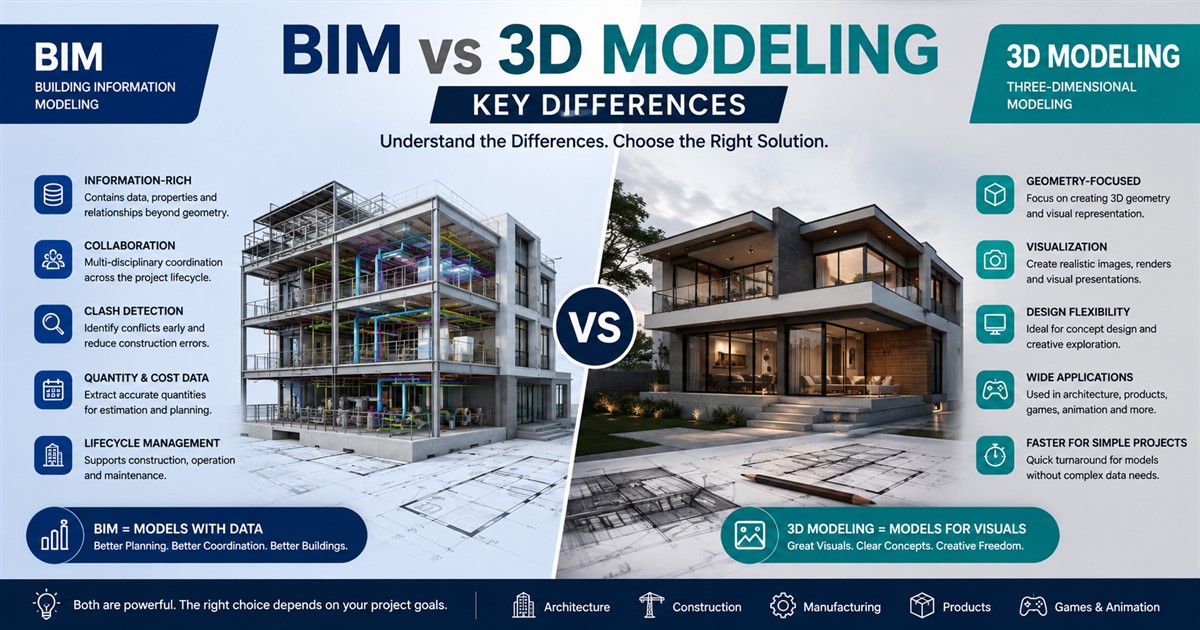
Building Information Modeling (BIM): This specialized architectural/engineering discipline commands some of the highest fixed-project rates, often exceeding $650 per project given its technical precision requirements.
What Actually Drives the Price
Beyond experience level and project category, a handful of specific factors explain most of the variation you’ll see in quotes:
File format and deliverables. A static mesh export for visual purposes only costs less than a fully parametric, editable native file. Delivering models in multiple formats (STEP, IGES, STL, OBJ, FBX) or building in client-side editability typically adds 10–25% to the base cost.
Revisions. Most quotes include two to three rounds of revisions in the base price. Beyond that, additional rounds commonly cost $25–$100 each, depending on how substantial the requested changes are.
Timeline. Rush delivery — anything under 48 hours — often carries a 25–50% premium over standard turnaround. If your timeline is flexible, you’ll generally pay less.
Software requirements. Projects that require specific professional CAD or engineering software tend to cost more than those using general-purpose 3D tools, both because of licensing costs and the narrower pool of qualified specialists.
Portfolio and proof of results. Modelers who can point to measurable business outcomes from past work — not just a nice-looking portfolio — can often charge 30–80% more than comparable talent without that track record.
The AI Factor
One of the biggest shifts heading into 2026 has been the rise of AI-assisted 3D generation tools. Platforms capable of auto-generating and customizing base meshes are compressing timelines for simpler assets, and that’s beginning to show up in pricing at the low end of the market. Entry-level assets — basic props or simple characters — that once ran $50–$200 are increasingly available in the $30–$150 range as AI tools handle more of the initial generation work, with human artists focused on refinement and quality control.
This doesn’t mean AI is replacing skilled modelers wholesale. Complex character work, hard-surface modeling, and anything requiring genuine artistic judgment still commands senior-level rates, because AI-generated base meshes typically need substantial human cleanup for professional use. If anything, the shift is pushing junior-level “generic asset” work toward automation while increasing the relative value of specialists who can do the parts AI still can’t.
Freelancer vs. In-House vs. Agency
Your engagement model affects total cost as much as the modeling itself does.
Freelancers offer the most flexibility and typically the lowest cost per hour, but you’re relying on one person’s availability, and quality can vary significantly between individuals. This works well for one-off projects or occasional needs.
In-house hires make sense if you need consistent, ongoing modeling work. Average salaries for a 3D modeler in the U.S. run roughly $78,000–$125,000 per year depending on experience, but the fully loaded cost to a business — factoring in benefits, software licenses, and hardware — is often close to double the base salary.
Studios and agencies sit at the top of the price range but offer team capacity, consistency, and reliability that a single freelancer can’t match. They’re the right call for ongoing production pipelines or projects where you can’t afford delays if one artist becomes unavailable.
How to Budget Realistically
Before requesting quotes, it helps to define:
- The project’s business purpose — a quick internal concept sketch has very different value than an asset for a product launch or investor presentation.
- Required file formats and editability — locking this down early avoids surprise costs later.
- Number of revision rounds you expect to need.
- Your actual timeline flexibility.
- Whether you need one asset or ongoing production support.
A well-scoped brief is the single best way to get an accurate quote and avoid the awkward mid-project cost creep that comes from ambiguous expectations.
The Bottom Line
Professional 3D modeling in 2026 spans an enormous price range — from $30 AI-assisted props to $5,000+ architectural renders — precisely because “3D modeling” covers such different kinds of work. The best approach isn’t to chase the lowest hourly rate, but to match the modeler’s experience level and specialization to what your project actually needs. A simple product prop doesn’t need a senior character artist, and a flagship product launch shouldn’t be trusted to the cheapest available freelancer. Define your scope clearly, get a few comparative quotes, and you’ll land in the right price range for the quality your project deserves.